2026-09-23 · 7 min · By Alcott Dube
How to choose injection moulding versus cnc for a first run
I compare first-run quantities, tooling commitments and geometry limits to decide when machining buys useful flexibility and when moulding justifies its higher upfront cost.
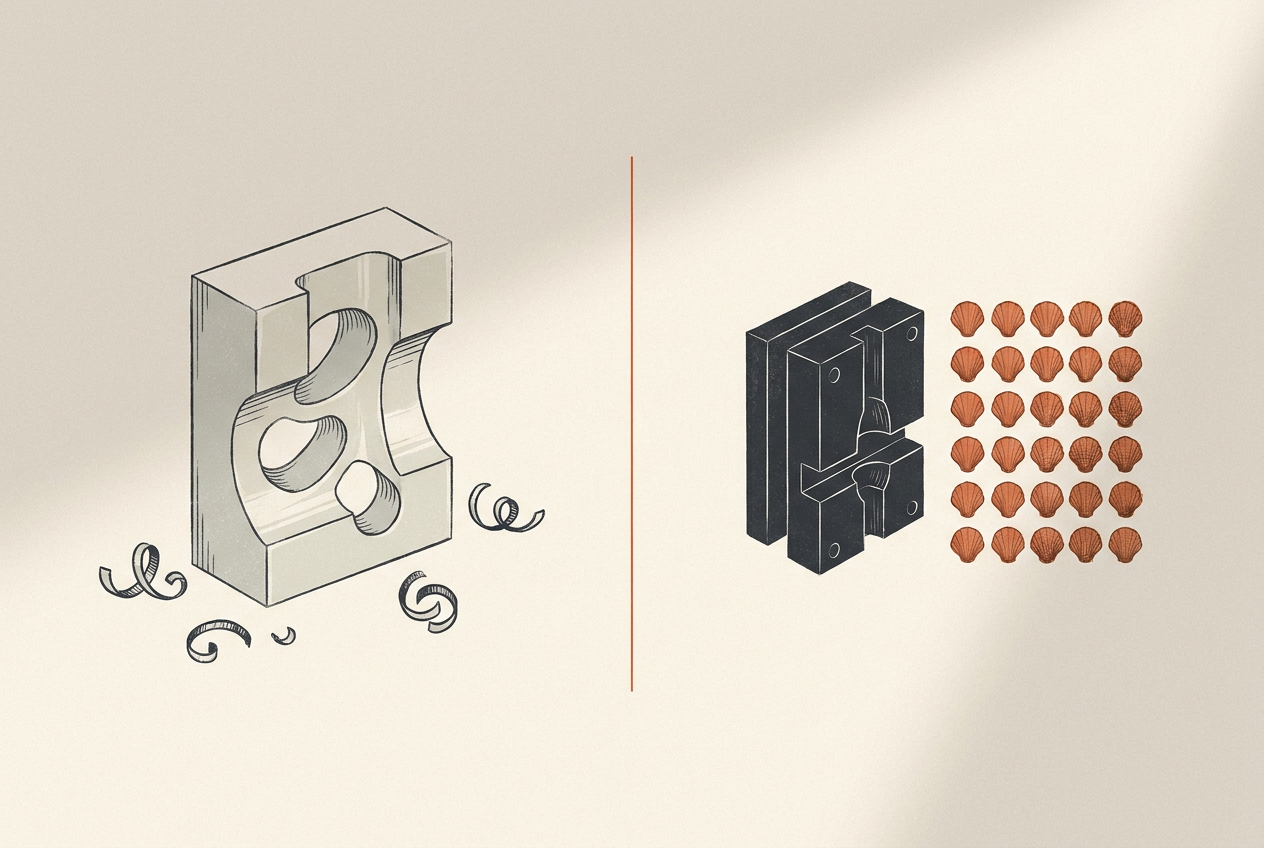
For a first run, I choose cnc machining when demand or geometry is still uncertain, provided the material and features are machinable. I choose injection moulding when credible repeat volume repays the tooling cost, the design is stable, and the part can be filled and ejected without expensive tool complexity.
How many parts justify injection moulding?
I start with the quantity I can justify ordering, not the annual sales forecast. A first batch of 80 parts and a possible requirement for 5,000 are different purchasing decisions. If demand depends on a trial, certification or a customer commitment, I treat the larger number as a separate scenario rather than guaranteed production.
There isn't a universal quantity at which moulding becomes cheaper. Protolabs and Xometry both describe the underlying trade-off: machining avoids a dedicated mould, while moulding spreads that initial investment across repeated parts. The crossover changes with part size, machining time, resin, cavity count and tool complexity. A simple turned spacer and a deep enclosure won't share a useful volume threshold.
I compare three quantities: the first order, the likely total before a design revision, and the credible repeat requirement. The middle figure matters most when the product is immature. If a mounting pattern may change after the first 100 units, I don't spread today's tooling cost across 10,000 unchanged parts. That calculation would make an uncertain design look artificially cheap.
How to calculate tooling cost break-even
I use a basic comparison before requesting detailed quotes: tooling cost divided by the difference between machined and moulded unit prices. This only works when both prices cover the same accepted part, material requirements and finishing operations. Comparing a finished machined component with an unfinished moulding gives a precise answer to the wrong question.
For an illustrative calculation, assume tooling costs £6,000, machining costs £24 per part, and moulding costs £4 per part. The £20 saving repays the tool at 300 parts. At 100 parts, machining totals £2,400 against £6,400 for moulding. At 1,000 parts, those totals become £24,000 and £10,000. These are invented inputs for explaining the calculation, not supplier prices or a market benchmark.
I then add setup charges, sampling, inspection, secondary operations and delivery to each route. If those fixed costs differ, I include the difference alongside tooling in the calculation. I also price a revision scenario: machining may need new programming, while moulding may need tool modification or replacement. The cheapest route at 1,000 unchanged parts can be the more expensive route if the first batch exposes a geometry problem.
Which geometry makes cnc machining expensive?
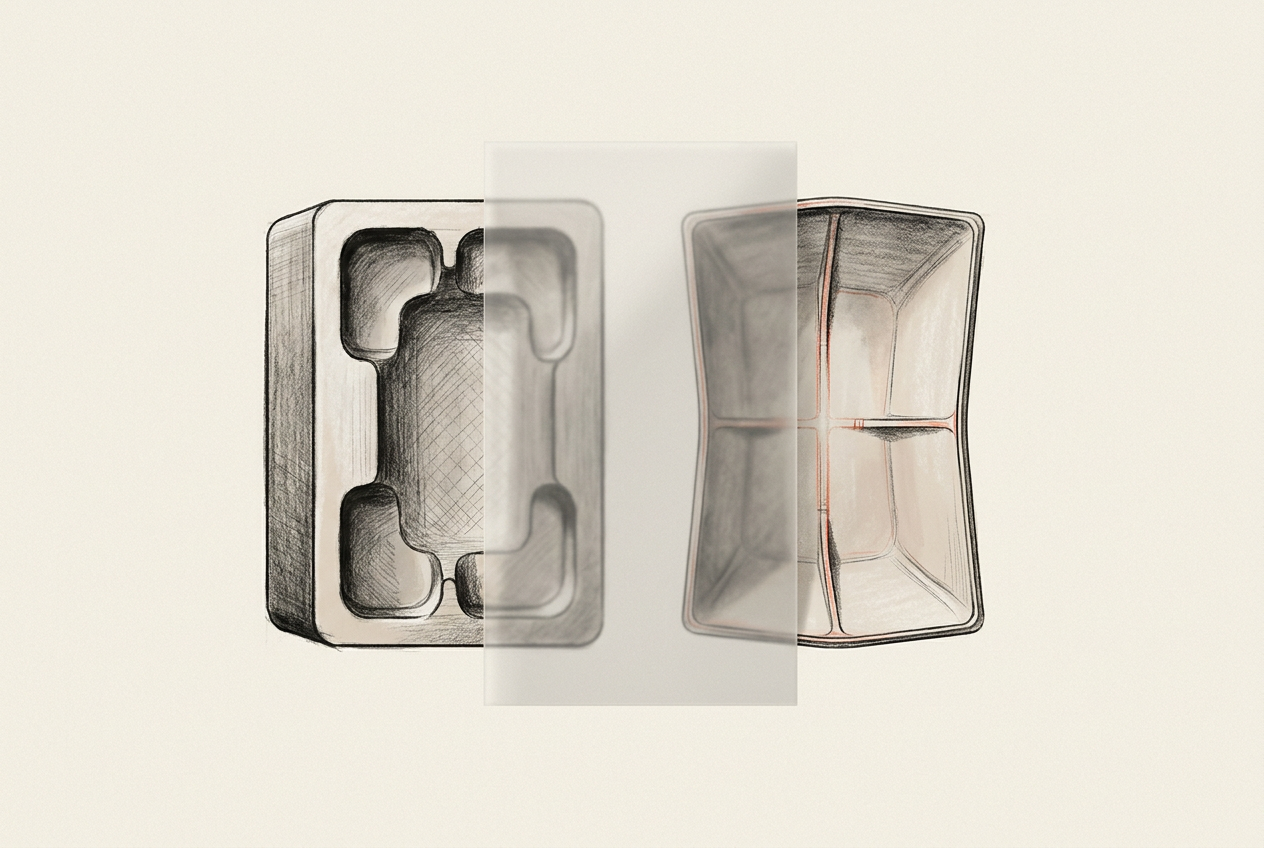
For machining, I inspect the model from the cutter's point of view. Can a tool reach each surface? Can the stock be held while material is removed? Protolabs' machining guidance treats tool access, feature proportions and internal radii as manufacturing constraints. A pocket that looks straightforward in cad can require a long, narrow cutter and slow machining.
I flag deep pockets, thin unsupported walls, sharp internal corners and features spread across several faces. Internal corners normally need radii because rotating cutters are round. A square mating component may need corner relief in its pocket, a changed mating shape or another manufacturing operation. I don't specify a tiny radius merely because the modelling software accepts it.
Setups matter as much as overall size. A small part with holes on five faces can require more handling and alignment than a larger plate machined from one direction. For a first run, I look for opportunities to combine hole directions, open inaccessible cavities or split a component into two simpler pieces. I include assembly labour before calling that split a saving. A lower machining quote is not automatically a lower delivered cost.
Which geometry needs redesign for injection moulding?
For moulding, I ask how plastic enters the cavity, how the part cools and how it leaves the tool. Protolabs and Xometry both emphasise wall thickness, draft and undercuts in their moulding guidance. These aren't details to add after choosing the process. They can change the exterior shape, internal space and way components fit together.
I aim for reasonably consistent walls rather than copying a machined solid into a moulding quote. Thick local masses can cool differently and contribute to sink or distortion. Ribs and cored sections can provide stiffness without retaining all that material. Their dimensions still depend on the resin and surrounding geometry, so I ask for a manufacturing review rather than treating a generic ratio as approval.
Walls parallel to tool withdrawal generally need draft, with the amount influenced by depth, material and surface texture. Undercuts may need side actions, inserts or a different part split, adding cost and constraints. I mark acceptable gate, ejector and parting-line locations before quoting. If an appearance surface or sealing face cannot tolerate those marks, the supplier needs to know immediately. I also keep machined prototypes honest: straight walls on a prototype don't prove a later drafted part will fit.
How to compare materials, tolerances and prototype tests
I don't assume a machined plastic prototype will behave exactly like an injection-moulded production part with a similar material name. Stock availability and moulding resin grades differ. Processing can also affect properties, particularly with fibre-filled materials. Xometry's material and process guidance is useful for narrowing options, but I confirm the actual grade and requirements with the supplier.
I separate fit checks from production-performance tests. A machined enclosure can verify connector access, screw positions and hand clearance. It cannot establish the final moulding's shrinkage, weld-line behaviour or snap-fit durability. If the decision depends on those outcomes, I budget for moulded samples and testing rather than treating a machined first run as equivalent evidence. That may justify tooling before demand alone would.
On the drawing, I identify the dimensions that control assembly and function. I avoid applying the tightest tolerance everywhere. Both routes become harder to quote sensibly when cosmetic edges receive the same requirements as bearing seats or sealing features. For a plastic part, I also specify relevant inspection conditions and agree how flexible features will be measured. Otherwise, two inspection methods can produce a dispute rather than useful evidence.
What to include in a first-run manufacturing quote
I send both suppliers the same revision, quantity scenarios, material requirements, critical dimensions and finish expectations. I include the drawing as well as the model, because geometry alone doesn't explain which faces seal, locate or remain visible. I request manufacturing feedback before accepting the price. A quote that quietly assumes a geometry change is not yet a comparable offer.
For moulding, I ask what the tool price includes: sampling, revisions, ownership, storage and maintenance responsibilities. I confirm cavity count, expected tool life and any restrictions on transferring the tool. For machining, I ask about setup charges, fixture costs and repeat-order pricing. For both, I separate dispatch estimates from the time needed to approve samples and resolve defects.
My final choice follows the next decision the batch must support. If I need to discover whether the assembly works or customers will buy it, I prefer the route with less irreversible spending, provided it can produce representative parts. If I need production-representative mouldings and credible orders cover the commitment, I authorise tooling after the geometry review. I record which changes would invalidate that decision before releasing the purchase order.
Questions people ask
Is cnc machining cheaper than injection moulding for 100 parts?
It can be, because machining avoids a dedicated mould, but 100 parts isn't a reliable cutoff. I compare complete batch costs: complex machining or an inexpensive, simple mould can change the result.
Can I injection mould a part designed for cnc machining?
Sometimes, but I expect a geometry review first. Solid sections, straight walls and inaccessible undercuts may need changes for cooling and ejection, which can affect fit and appearance.
Can cnc machining be used for plastic production parts?
Yes, machining can produce usable plastic production parts, not just prototypes. I check stock-grade availability, dimensional stability and machining constraints before specifying it, especially for thin walls or parts exposed to heat and chemicals.
Should I machine a prototype before paying for a mould?
I usually would if it can expose assembly or geometry errors cheaply. I wouldn't rely on it to validate moulding-specific behaviour such as shrinkage, weld lines or gate appearance; those require production-representative samples.